Supplier Admin
Keeps records, certifications and compliance documents current
“Did I miss any required documentation?”
Case study · PepsiCo · Procurement
Proof of concept, still in progress · some flows simplified
How I shaped a fragmented supplier experience, a 90-day invoice cycle and an overwhelmed help desk into one modular portal concept, and the MVP strategy behind it.
 By Atulesh Kumar
The problem
Picture a business that supplies one of the world’s largest food and beverage companies. To confirm an order, you open one system. To check an invoice, another. To find out when you’ll be paid, you email someone and wait.
For PepsiCo’s suppliers, that was normal: more than twelve tools and dashboards, and an average invoice cycle of over 90 days. Supplier Hub set out to replace all of it with a single front door.
The brief asked for a portal, and our research quickly showed a much bigger business problem.
12+
Tools and dashboards each supplier had to navigate
65%
Suppliers with no real-time view of their purchase orders
18%
Invoices blocked by retroactive purchase orders
3–5 days
Added to invoice processing by manual review
90+ days
Average invoice cycle
$10–15M
Lost every year to support tickets and staff time
When a supplier needs twelve tools to get paid, the design is what’s broken.
The call
Supplier Hub was scoped as an MVP proof of concept on a tight timeline. There was no room for months of research and rounds of usability testing, and I’m candid about that trade-off.
So I made a bet on structure: a foundation that could grow. Every part of the portal would map to a distinct user intent and its own backend service, so the business could roll out in phases with minimal dependencies, and later research could sharpen the product without rebuilding it.
Research
The work started inside PepsiCo. I interviewed a procurement manager, a finance director in accounts payable, legal counsel, an IT systems lead and a category manager to map how supplier issues travelled through the business, and where they got stuck.
From that synthesis, I designed for three people:
Keeps records, certifications and compliance documents current
“Did I miss any required documentation?”
Confirms purchase orders and resolves delivery discrepancies
“Do I have all my POs?”
Submits invoices and chases payment status
“Has it been processed yet?”
Across all three, the pattern was the same. Order confirmations depended on email. Payment status was invisible. The help desk was flooded with “where is my invoice?” questions, and nobody could track a contract outside their inbox.
Mapping how PepsiCo’s suppliers actually worked showed the gaps. Orders and invoices were covered, but piecemeal. Contract visibility was missing, and suppliers had no view of their own performance or a place to learn.
That shaped where Supplier Hub would lead:
Design
The research pointed to five capability zones, and I made them the spine of the information architecture.
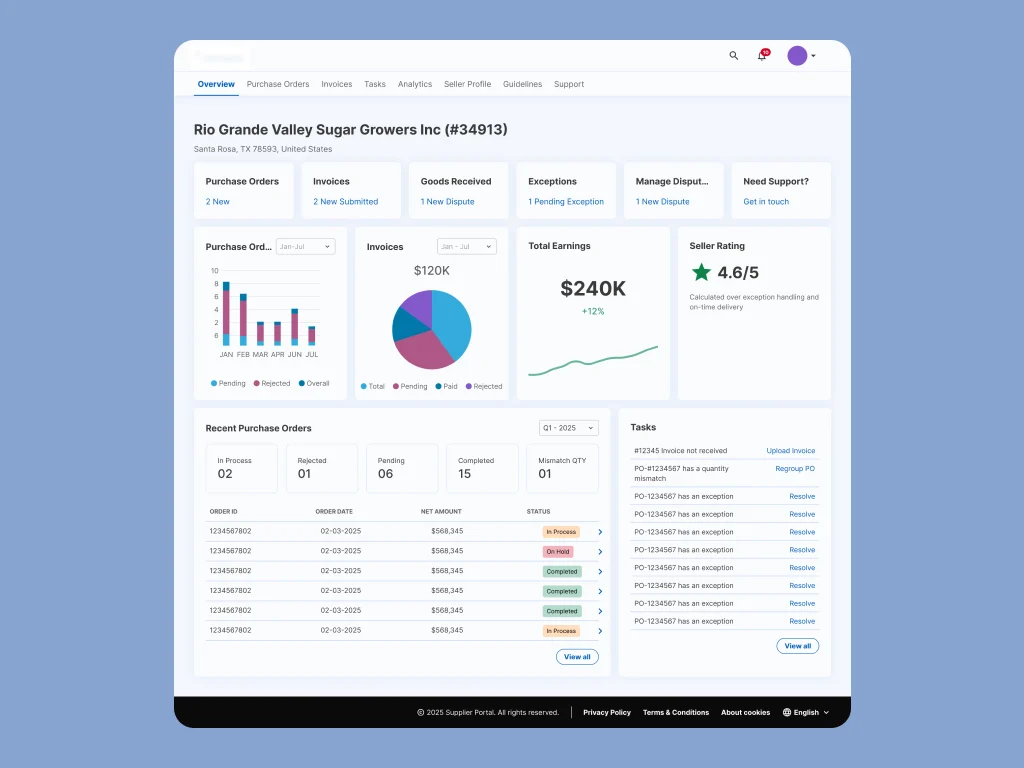
The dashboard brings them together. Quick actions surface new orders, invoices and disputes. A performance summary shows earnings and seller rating. Recent orders carry clear statuses, and a task list turns every exception into a one-click action.
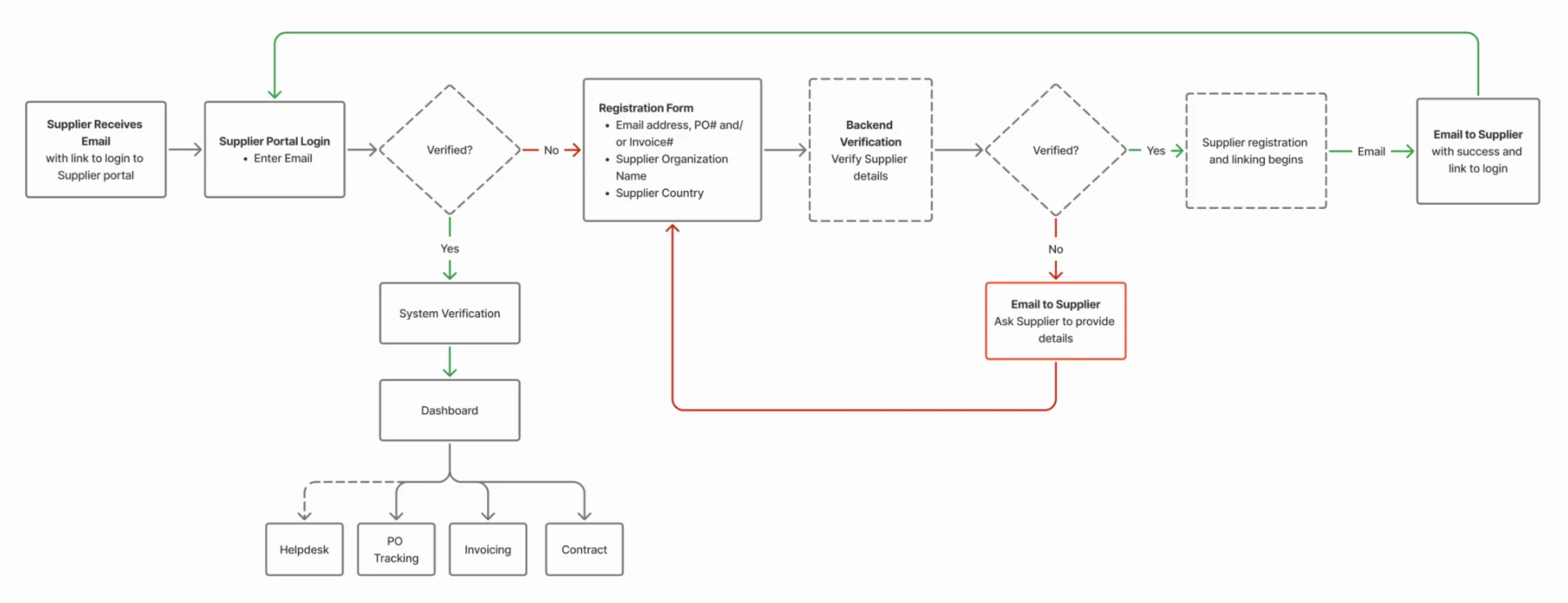
Onboarding is where most supplier portals lose people. Supplier Hub verifies suppliers against data they already have, like a PO or invoice number, and routes anyone who can’t be matched straight into a guided registration.
Outcome
The concept is still in progress, so these are the targets it was built around:
You can move fast and still be rigorous. When research time is short, the structure has to carry the weight: modular zones, clear intents and phased delivery leave room for the product to keep learning as it moves towards launch.
Supplier Hub is designed to keep getting better with every phase.
Building something complex? Let’s talk.
Inquire